


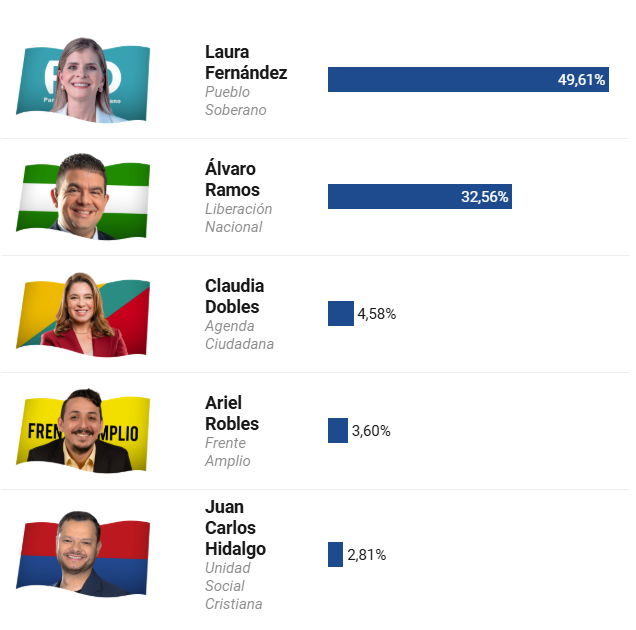
Laura Fernández, candidate of the Sovereign People Party (PPSO), won Costa Rica’s presidential election in the first round on Sunday, February 1, 2026. According to the latest count released by the Supreme Electoral Tribunal (TSE), she secured 839,039 votes, representing 49.61% of the ballots cast, with 75.9% of polling stations counted at the time of the official announcement.
At 39 years old, Fernández will become, on May 8, the second woman president in Costa Rica’s history, after Laura Chinchilla (2010–2014). A former cabinet minister and the handpicked successor of outgoing president Rodrigo Chaves—a leading figure of the Costa Rican right, whose style and rhetoric have at times been compared to Trump-era politics—Fernández campaigned on a tougher security agenda as the country confronts rising violence linked to drug trafficking and organized crime.
While the result confirms political continuity with the outgoing administration, it also reveals a more nuanced reality: Laura Fernández enters the presidency with strong electoral legitimacy, but without the parliamentary base that would ensure full control of the political agenda.
An expected but incomplete victory
Fernández’s victory followed a scenario largely anticipated by opinion polls. A survey by the CIEP at the University of Costa Rica, published on January 27, already placed her in the lead with 43.8% voting intention, while 26% of voters remained undecided less than a week before election day.
The ballot box confirmed the trend—but did not deliver the legislative momentum the governing party had hoped for.
Behind Fernández, Álvaro Ramos of the National Liberation Party (PLN) finished second with 32.56% of the vote. Far behind came Claudia Dobles (Citizen Agenda Coalition) with 4.58%, Ariel Robles (Broad Front) with 3.60%, and Juan Carlos Hidalgo (Social Christian Unity Party – PUSC) with 2.81%.
This dispersion of votes highlights a highly fragmented political landscape, both within the opposition and in the future composition of the legislature.
Who is Laura Fernández?
A trained political scientist and former senior executive official, Laura Fernández built her political career at the heart of government, holding several key cabinet positions. Her candidacy was explicitly framed as a continuation of “Chavismo”, in a context marked by strong political polarization and a divided opposition.
Throughout the campaign, her close ties to the outgoing administration drew criticism, particularly regarding the influence of prominent ruling figures such as lawmaker Pilar Cisneros. Her decision to avoid several public debates and forums also fueled controversy, raising questions about her leadership style and approach to accountability.
She will be joined in office by vice presidents Francisco Gamboa Soto and Douglas Soto Campos.
Legislative Assembly: the Achilles’ heel of the new presidency
It is in the legislature that the limits of Fernández’s victory become most evident. The ruling party failed to reach its strategic goal of 40 seats, a threshold presented as necessary to push through major institutional and judicial reforms.
Current projections give the PPSO around 30 seats out of 57—a significant bloc, but insufficient to govern without constant negotiation. This reality places Fernández at the head of an executive branch that will need to bargain, persuade, and compromise to advance its agenda.
In short, the president-elect has electoral legitimacy, but not full institutional control.
Immediate challenges in a constrained environment
Security. The most urgent challenge is tackling violence linked to drug trafficking and organized crime. Costa Rica ended 2025 with 873 homicides, a rate of 16.7 per 100,000 inhabitants, one of the highest in its recent history. Public expectations are high, but political room for maneuver may be limited by parliamentary arithmetic.
Education. Education will also demand swift action. PISA 2022 results show worrying declines, particularly in mathematics, with a 17-point drop, and weaker reading performance compared to 2018.
Infrastructure. Chronic delays in infrastructure projects point to structural planning and execution problems. In 2024, the Ministry of Public Works and Transport (MOPT) reported that key sections of San José’s ring road were only 70% complete, despite years of work.
Foreign investment and relations with the United States. Economically, the new president inherits a model heavily dependent on foreign direct investment (FDI). With USD 3.533 billion in FDI by Q3 2025, Costa Rica remains attractive—but vulnerable to external shocks. U.S. trade policy under President Donald Trump, marked by renewed protectionism, could affect supply chains and investment flows.
Political continuity, institutional fragility
Laura Fernández begins her term facing a central paradox: a clear presidential victory paired with uncertain governability. In a fragmented Congress and amid lingering tensions between the executive and legislative branches, every reform will require alliances, compromise, and dialogue—qualities not always dominant in recent political cycles.
As the TSE continues updating official results, the president-elect enters a decisive transition phase. Security and economic confidence top her priorities, but her ability to govern without a solid majority will ultimately shape the trajectory of her presidency.
A 2026–2030 term under close scrutiny
Laura Fernández will take office in a demanding context, where the public expects rapid results while institutions remain vigilant in protecting democratic checks and balances.
If the electoral verdict is clear, the verdict on governance remains unwritten. More than ever, the success or failure of this presidency will depend on whether an electoral win can be transformed into durable political leadership—within a system where power is not decreed, but built day by day.
Historical context of Costa Rican politics
Historically, Costa Rican voters have leaned toward the political center rather than clearly right or left. Since the end of the 1948 civil war, the country has been shaped by a strong social state inspired by social democracy, marked by universal healthcare, major investments in education, and the abolition of the army. This legacy fostered deep attachment to public services, institutional stability, and the rule of law, while remaining socially conservative on several cultural issues.
Over time, economic openness, fatigue with the traditional two-party system, and corruption scandals transformed voter behavior. Costa Rican voters became more pragmatic, skeptical, and volatile, moving away from ideological labels toward concrete concerns. Today, elections revolve less around left-right divisions than around security, state effectiveness, and anti-corruption, favoring personalities perceived as capable of action.
It is within this historical framework that Laura Fernández’s election must be understood. Her 2026 victory does not signal a clear ideological shift to the right, but rather a context-driven reaction by a centrist electorate frustrated with perceived state inefficiency and rising insecurity. Voters chose a promise of order, authority, and results over a clearly defined ideology—accepting a firmer executive as long as it remains institutionally constrained.
Fernández’s victory therefore resembles a conditional vote of confidence. She enjoys real electoral legitimacy, but governs within a restrictive institutional framework shaped by a fragmented Parliament and a democratic tradition that limits excessive concentration of power. Far from a blank check, the 2026 election reflects the continuity of a historically centrist electorate—demanding results while remaining deeply attached to checks and balances.
- Avec l’Excelsior et le Goombay : découvrez le golfe de Papagayo dans toute sa splendeur
- Expatriés au Costa Rica : pourquoi la résidence légale devient-elle si importante?
- La Floride perd-elle ses snowbirds au profit du Costa Rica?
- Tamarindo Natura Lodge: Une oasis de tranquillité près de Tamarindo
- Tout crisser là et s’expatrier ?