

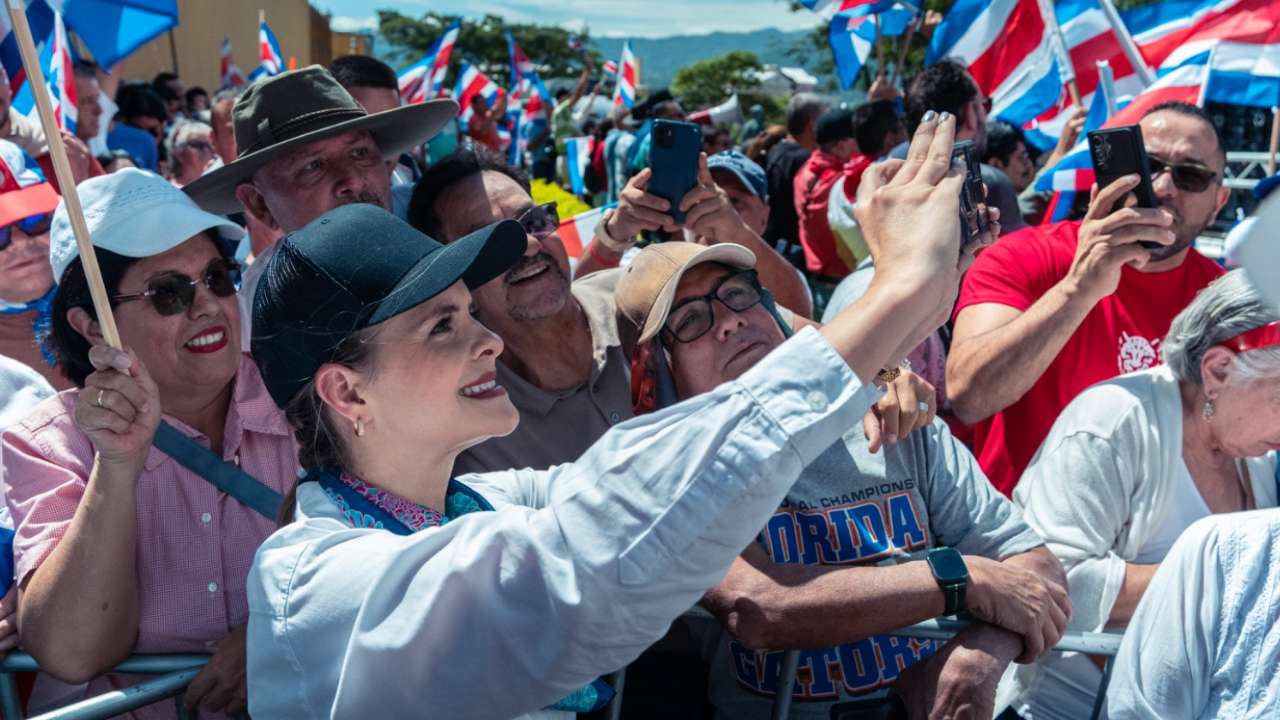
As Costa Rica’s 2026 presidential election approaches, Laura Fernández Delgado is increasingly emerging as a central figure on the national political stage. The candidate of the Partido Pueblo Soberano (People’s Sovereignty Party) has moved from being an influential minister at the heart of government to the clear front-runner in the presidential race. Carried by a message of continuity and buoyed by favorable public opinion, she now stands firmly in the spotlight.
Founded and officially registered in 2023 with Costa Rica’s Supreme Electoral Tribunal (TSE), the Partido Pueblo Soberano did not exist during the 2022 presidential election. It emerged in the wake of Rodrigo Chaves’ rise to power, amid a broader political realignment around his movement, and quickly became the main platform associated with the continuity of the current government heading into the next election.
Following the 2022 election, the Partido Progreso Social Democrático—the party under which Chaves was elected—was weakened by internal conflicts, limited territorial organization, and strategic disagreements. This situation made it necessary to create a new electoral vehicle capable of carrying the government’s political legacy, discourse, and priorities toward 2026.
According to the latest poll conducted by Opol Consultores, released just before Christmas, Laura Fernández is very close to winning in the first round. The survey gives her 39.45% of voting intentions, less than one point below the 40% threshold of valid votes required to avoid a runoff election scheduled for April.
From Influential Minister to Presidential Candidate
A trained political scientist, Laura Fernández first gained prominence as a key figure within the current administration. She served as Minister of National Planning and Economic Policy before becoming Minister of the Presidency, a strategic position that placed her at the center of government coordination and direct relations with the Legislative Assembly. This trajectory has made her one of the figures most closely associated with outgoing president Rodrigo Chaves.
Polls Showing a Dominant Position
According to the Opol Consultores survey, Fernández is nearing 40% of voting intentions, placing her just below the threshold needed to avoid a second round. She leads her closest rivals by a wide margin, although the poll also highlights a high percentage of undecided voters. This detail is crucial: while it confirms her dominant position, it also shows that the campaign remains open and that the outcome is not yet mathematically sealed.
Far behind in second place is Álvaro Ramos of the National Liberation Party (PLN) with 5.64%, followed by Ariel Robles of the Frente Amplio, who stands at 3.13%. The poll also reveals that 33.77% of voters remain undecided, a factor that could prove decisive in the final outcome of the race.
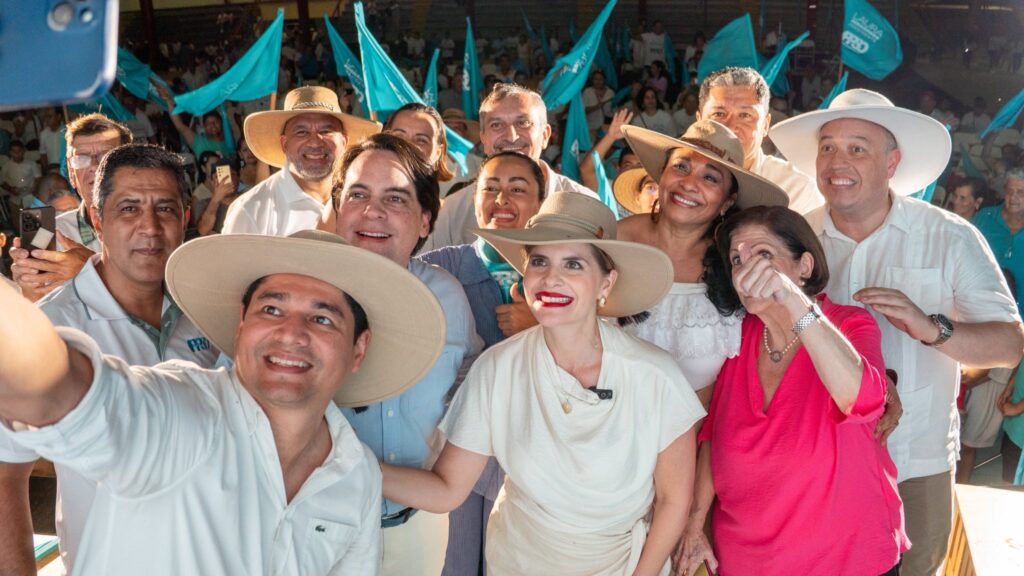
The candidate addresses citizens across the country with a message of hope and confidence in the future. Through her speeches and travels, she seeks to unite voters around the idea of a forward-looking Costa Rica, driven by stability, continuity, and political renewal.
“The best for Costa Rica is yet to come! Our future president Laura Fernández and her team of 40 deputies!” — Mireya Zamora Alvarado 🇨🇷
The Candidate of Government Continuity
Laura Fernández’s candidacy is inseparable from the current administration. Although Rodrigo Chaves was elected in 2022 under the banner of the PPSD, the Partido Pueblo Soberano has now become the main political vehicle of the governing movement. Fernández therefore clearly presents herself as the candidate of continuity, embracing the political legacy, style, and priorities of the outgoing government.
Values and Political Orientation: Where Does Laura Fernández Stand?
Ideologically, Laura Fernández and the PPSO generally position themselves on the center-right. Their discourse emphasizes a liberal economic approach focused on state efficiency, fiscal discipline, attracting investment, and cooperation with the private sector. On social issues, the party adopts more conservative positions, often linked to the defense of traditional values and a cautious stance on certain societal debates. This combination largely mirrors the political orientation of the Chaves administration.

A Woman in a Still Male-Dominated Political History
The question of female leadership also holds symbolic weight in this campaign. Costa Rica has had only one female president in its history: Laura Chinchilla, who served from 2010 to 2014. A victory by Laura Fernández would therefore make her only the second woman to reach the country’s highest office—an important milestone in a political landscape still largely dominated by men.
Rodrigo Chaves’ Legacy: Asset or Burden?
The legacy of Rodrigo Chaves, which Laura Fernández partially embraces, is both an asset and a challenge. His government is praised by supporters for what they see as more rigorous economic management and for its confrontational stance toward what he calls the “old political class.” At the same time, his direct style, frequent clashes with institutions, and governance-related controversies have deeply polarized Costa Rican society. Fernández will need to show that she can preserve achievements while easing tensions.
Key Dates to Watch
On the electoral calendar, the first round of the presidential election is scheduled for February 1, 2026. If no candidate obtains at least 40% of valid votes, a runoff election will take place on April 5, 2026. The coming weeks will therefore be decisive, particularly in winning over undecided voters.
Conclusion: A Pivotal Moment for Costa Rica
Laura Fernández embodies a pivotal moment for Costa Rica. She represents both the continuity of a government that has left a strong mark on its era and the possibility of a new chapter—especially as a woman running for the presidency. Her ability to transform support for the outgoing president into personal endorsement, while reassuring a divided electorate, will likely be the key factor in this campaign. By February 2026, the question will not only be who leads in the polls, but who can unite broadly enough to govern a country seeking stability and renewed confidence.
Join us for an insightful discussion with Fernando Alfaro, a distinguished attorney who specializes in helping expats navigate life in Costa Rica. With years of experience, Fernando emphasizes that understanding Costa Rica’s legal and constitutional framework is essential—not just as a set of rules, but as a reflection of the country’s values and its unique way of life.
- Avec l’Excelsior et le Goombay : découvrez le golfe de Papagayo dans toute sa splendeur
- Expatriés au Costa Rica : pourquoi la résidence légale devient-elle si importante?
- La Floride perd-elle ses snowbirds au profit du Costa Rica?
- Tamarindo Natura Lodge: Une oasis de tranquillité près de Tamarindo
- Tout crisser là et s’expatrier ?