

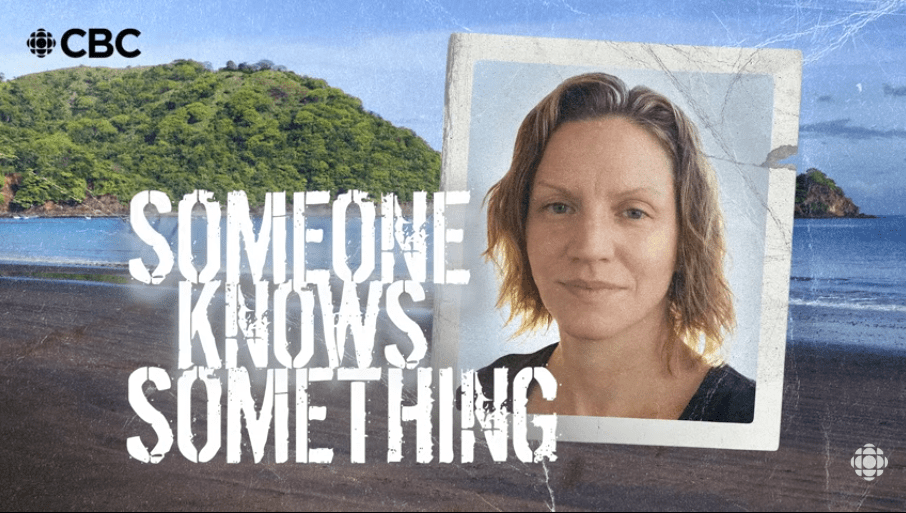
Costa Rica with its golden sunsets, warm Pacific waters, and promise of renewal, has long attracted those seeking a different rhythm of life. For many expatriates, it represents escape, healing, and reinvention.
But on the night of August 17, 2021, that promise was abruptly broken.
Jaclyn Ferland-Smith, a 40-year-old Canadian woman, vanished from her home in the Cacique Development, between Playa Hermosa and Playas del Coco. She was last officially seen that evening, and from that moment on, she seemingly disappeared without a trace. No confirmed sightings. There was no financial activity. No evidence of departure from the country.
Only questions remain.
Today, years later, her story returns to the forefront through a powerful new season of Someone Knows Something — a series that has built its reputation on digging deeper, listening longer, and refusing to let silence win.
A Series That Refuses to Let Go
Created, written, and hosted by award-winning Canadian journalist David Ridgen, Someone Knows Something is widely regarded as one of Canada’s most respected long-form investigative crime series. Its strength lies not only in its rigorous approach to facts, but in its deeply human storytelling — one that seeks not just answers, but understanding and, ultimately, closure for families.
Now released across multiple platforms, this new season casts a renewed and sharper light on Jaclyn’s disappearance. It reopens the case from the ground up—questioning assumptions, revisiting timelines, and amplifying the voices of those who have endured years of uncertainty.
In exclusive comments to Mag506.com, David Ridgen explains the mindset behind his investigation:
“I try not to enter investigations with a predetermined set of thoughts about what did or did not happen. I look at facts, and anything that cannot be confirmed as a fact gets additional scrutiny until I can either discount it or at least explain it.”
That disciplined approach becomes essential in a case like Jaclyn’s, where facts are few, and narratives often conflict.
A Life Between Beauty and Struggle
Through interviews with family members and those who knew her, a portrait of Jaclyn begins to emerge — one far more complex than the surface suggests.
“She was very athletic, at times competitively so,” Ridgen shares. “She loved to exercise and be on the water and seemed to always be in motion, walking or running everywhere. At the time of her disappearance, Jackie was a vegetarian and careful about what she ate. She enjoyed being surrounded by nature, so Costa Rica was a great place for her.”
She embraced the country fully — photographing sunsets, capturing images of birds and flowers, planting banana trees in her backyard, and sharing those moments with her family back in Canada. Neighbors remember her as friendly, often smiling, always greeting those around her. But beneath that vibrant exterior, there were signs of internal struggle.

“Beneath the surface, Jackie was struggling with her mental health,” Ridgen explains. “Sebastien told me they fought increasingly, especially after their arrival in Costa Rica. And sometimes these fights got physical. There were people who witnessed this.”
This duality — a life of beauty intertwined with personal turmoil — becomes central to understanding the events that unfolded.
The Night She Disappeared
According to the account given by her husband, Sebastien Ferland, Jaclyn left their home on foot following a conflict on the evening of August 17, 2021.
“And on that night,” Ridgen explains, “Jackie walked away after a fight — Sebastien says — and she never came back.”
It is a moment that sits at the very heart of the mystery. A seemingly simple action—walking away—that somehow led to a complete disappearance. From that point forward, every detail matters. Every inconsistency matters. Every version of events matters.
A video interview broadcast on Pepito Live in Costa Rica can be viewed here, in which Sebastien Ferland explains his wife’s disappearance at the time (click here to watch on YouTube).
Among the various theories circulating within the community, one in particular has drawn renewed attention in Ridgen’s investigation: the possibility that Jaclyn may have left the area by taxi. This scenario, along with other versions of events, is carefully re-examined as part of a broader effort to challenge assumptions and revisit overlooked leads.
“The most important thing to look at in any case is story consistency,” Ridgen emphasizes in his comments our magazine. “Are the stories that people are telling the same over time, or do they feature differences in repeat tellings? And if so, what kind of differences and how substantive are they?”
The Search That Followed
David Ridgen explains that in the immediate aftermath, Costa Rica’s Judicial Investigation Agency (OIJ) carried out an initial investigation. A cadaver dog was deployed, limited forensic tests were conducted, and a number of individuals were interviewed.
Meanwhile, Jaclyn’s family traveled from Canada to take part in the search, holding on to the hope that answers would come quickly.
Krista Marshall, who had previously met Jaclyn, issued a call to the community and helped coordinate civilian search efforts. As a volunteer team leader, she recalls: “Around 30 to 40 people turned out for the initial civilian search.
She describes an extensive and physically demanding operation: “The OPEN team ranged from 7 to 10 people at a time, between the ages of 14 and 50. Using printed maps, we divided the area into search zones and expanded them as needed. We cut our way through dense, overgrown bush—especially challenging during the rainy season. Boats volunteered to assist with water searches, drones were used to scan from above, and some team members even rappelled down cliffs to search below.”
“The central problem here,” Ridgen explains, “is not being able to find Jackie. Where did she go?”
Without a body and without definitive evidence, the investigation faced its greatest obstacle: uncertainty.
Questions About the Investigation
One of the most compelling aspects of this new season is its willingness to examine not only the disappearance itself, but the investigation that followed.
In his interview with Mag506.com, David Ridgen offers a measured but candid assessment:
“I think that the OIJ undertook a basic investigation. They used a cadaver dog, used forensic methods to conduct a test or two, talked to a few people. But in my opinion, I think OIJ could have done much more to secure the scenes of the day Jackie was last seen.”
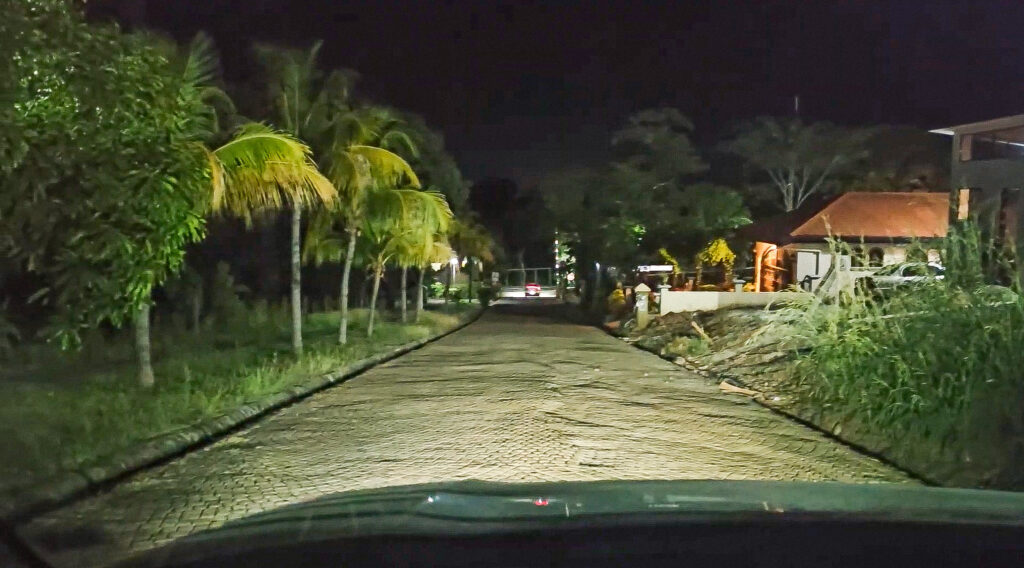
He points to missed opportunities that, in his view, could have made a difference — additional witness interviews, more extensive searches, deeper forensic analysis, and a broader effort to map Jaclyn’s final movements.
“This expansion of investigation in the early moments is crucial,” he adds. “The data points they missed could have helped give a fuller map of the evidence. More data helps to prove things more definitively and decisively. Less data leads to more rumor and hysteria.”
Public Voices, Growing Frustration
The series has also reignited public discussion. Viewers are not just watching — they are reacting, questioning, and demanding more.
In the comment section of Episode 6, Adeline Proulx expressed a sentiment shared by many: “Sadly, if this case would’ve been in the United States or Canada, it probably would’ve been closer to being solved… The truth has a way of eventually coming out.” It is a difficult statement, but one that underscores a broader concern about investigative limitations and missed opportunities.
A Community That Still Remembers
While official efforts may have slowed over time, the impact of Jaclyn’s disappearance has never truly faded for those who were involved in the search.
Krista Marshall, one of the leaders of the volunteer search efforts and a participant, shares her perspective:
“I think David Ridgen did a great job with the series. I appreciate him bringing attention to Jaclyn and keeping her present in people’s minds. Her family is struggling with her loss, especially without closure. I can’t imagine what they go through every day.”
Her words reflect a reality often overlooked in unsolved cases: the enduring pain of not knowing. But Krista also believes there is more to this story — answers that may still be out there, waiting to surface.
The Unanswered Question
At the center of it all remains the question no one has been able to answer: what really happened to Jaclyn Ferland-Smith?
Did she choose to leave? Did she suffer an accident? Or did something far more serious occur? In exclusive comments to Mag506.com, David Ridgen confronts these possibilities head-on:
“Did Jackie choose to end her life, or did someone take it? If she chose to end her life, did she also meticulously plan how not to be found? Did she take a taxi to her suicide? If someone else took Jackie’s life or was present when she died, 100% they know what happened. And they should speak now.”
During the series, Sebastien Ferland firmly denies any involvement, expressing frustration at being perceived as a suspect: “I did not kill her, obviously. People want to see me as the guilty one. Whatever I do, they’re going to think it’s me. Who am I to convince anyone?”
He also raises the possibility that Jaclyn may have taken her own life. But this theory leaves a haunting question unanswered: how can someone commit suicide and disappear completely? His words reflect the weight of suspicion that has followed him since Jaclyn’s disappearance — a reality shaped as much by unanswered questions as by the absence of definitive evidence.
Keeping the Case Alive
For David Ridgen, one principle remains unwavering: cases like this should never be closed prematurely. “I think all cases should be left open and not archived until they are definitively solved,” he states. “Without Jackie herself being found, it makes it difficult but not impossible. There is still more to do.”
That conviction lies at the core of this new season—an unyielding refusal to accept silence as an answer.
“If anyone believes they have information,” Ridgen says in a message to Mag506.com readers, “they should come forward. Anyone who thinks they may have seen Jackie, spoken to her, or communicated with her around August 17, 2021, should contact the OIJ or reach out directly.”
He goes further, speaking directly to those who may hold critical knowledge:
“Confessions… are a prime way that both the perpetrator and the victim’s family and community can benefit. I have seen that the release of the truth is like a salve that can repair — or at least relieve. If there is someone who has that kind of information, I would urge them to speak now.”
David Ridgen encourages anyone who may have information related to the case to contact Costa Rica’s OIJ (Organismo de Investigación Judicial), the country’s national investigative police responsible for criminal cases, or to reach him directly by email at: david.ridgen@cbc.ca
Conclusion: Watch, Share, Speak
This new season of Someone Knows Something is more than a true crime series. It is a continuation of a search that never truly ended. It is an invitation to look closer, to listen more carefully, and to refuse indifference.
In the In the Search for Jaclyn Facebook group, Bre Chalmers posted: “May this (series) reach new ears and eyes around the world. Sending hope to all who are still searching for Jaclyn ❤️
Jaclyn Ferland-Smith is not just a missing person. She is a story unfinished. A life interrupted. A family still waiting. Watching this series is not passive. It is participation. Keeping his name alive. It is ensuring that her disappearance is not forgotten in the passing of time.
Because somewhere, somehow, someone knows something.

Laisser un commentaire