


Louise is wrapping up her vacation in Costa Rica. Her flight departs early in the morning from Liberia International Airport, and to avoid stress, she accepts the contact of a driver passed along by a neighbor she met during her stay. “A friend, someone reliable,” she’s told. The price is agreed upon in advance for the airport transfer. On the way, everything seems fine… until arrival.
The driver suddenly announces a higher fare. His explanation: heavier-than-expected traffic and extra time. Pressed by her flight departure, Louise pays an additional 20 dollars. Too late, she realizes she has just been overcharged by an illegal “pirate” taxi, with no receipt, no proof—and no recourse.
Illegal taxis exist everywhere, especially where regulation is weaker
Illegal taxis are not a problem limited to large cities. They are common, and many tourists like Louise do not know how to distinguish a legal taxi from an illegal one—or understand the risks involved. These unlicensed taxis can be found throughout Costa Rica and are often more prevalent in small tourist communities, where taxi services are less structured or less visible.
In destinations such as Puerto Viejo de Talamanca, Playa Sámara, or Playa del Coco, the relaxed atmosphere can create a false sense of security. Yet the risks remain exactly the same, regardless of how peaceful or welcoming the destination may seem.
“He’s a friend of a neighbor”: a very common trap
If the vehicle you enter does not clearly display an official taxi identification on the outside—specifically a yellow triangle—it is not a legal taxi. In that case, the vehicle is illegal, and you are not protected, neither legally nor through insurance. No matter what the driver says, how reasonable the price sounds, or who recommended the ride, no yellow triangle means no protection.
An illegal taxi is a vehicle that transports passengers without official authorization. It is not subject to government oversight, does not carry the insurance required for tourist transportation, and offers no clear legal responsibility to the passenger in case of an accident, theft, abuse, or dispute.
“Getting into an illegal taxi means entering a world you don’t know,” explained Franck Quiroz, a lawyer based in San José. He recalls the disturbing case of Carlos, a father of four young children whose life changed dramatically after trying to save time and money.
Carlos decided to take an illegal taxi for a short trip. Along the way, the vehicle was stopped at a police checkpoint. Drug-sniffing dogs were present and immediately alerted officers to the taxi. Unknown to Carlos, the driver had one kilogram of cocaine hidden under the passenger seat.
Carlos was arrested on the spot, detained, and later faced criminal charges, while the driver was quickly released. It took several years of legal proceedings for Carlos—an innocent, law-abiding citizen—to clear his name and escape what became a true nightmare.
This case highlights a harsh reality: when you take an illegal taxi, you expose yourself to risks you cannot foresee or control, sometimes with devastating consequences.
An accident without insurance: the most serious risk
The most dangerous scenario occurs when an accident happens. Jean and Lucie were using an unlicensed taxi recommended during their stay. After a collision, they discovered the driver had no valid insurance for transporting passengers. Medical expenses were entirely their responsibility, and their travel insurance refused coverage. The driver faced no legal consequences. No matter the region, the outcome is always the same.
How to recognize a legal taxi in Costa Rica
In Costa Rica, identifying a legal taxi or licensed transport provider is simple—even in small tourist towns. An official taxi is red, displays a clearly visible yellow triangle on the door, has a license number, and uses a regulated taximeter. Licensed tourist transport vehicles clearly display the word “Turismo” on their van or minibus.
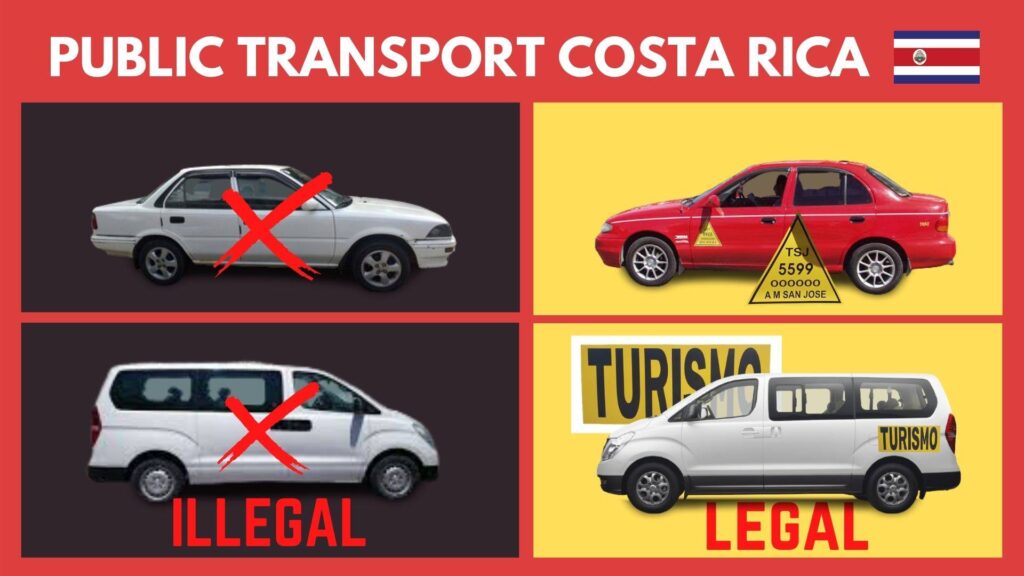
The absence of a yellow triangle automatically means the vehicle is not legal, regardless of the driver’s explanation. At airports, authorized taxis are orange and operate with fixed fares based on destination.
Red taxis are strictly regulated by the government, and their fares are set—and regularly adjusted—by the Public Services Regulatory Authority (ARESEP). The mandatory use of a taximeter eliminates price negotiation between driver and passenger, ensuring a transparent and lawful service nationwide.

A clear message from authorities: formal transport first
The Public Transportation Council (CTP), supported by the National Insurance Institute (INS), strongly urges residents and visitors to prioritize officially regulated taxis. This is not an ideological stance—it is a legal one. Today, the official taxi is the only form of individual paid transport that provides full legal and financial protection to passengers.
Why official taxis offer real protection
Taxis authorized by the CTP must comply with strict requirements aimed directly at passenger safety. They must maintain mandatory insurance policies with the INS, covering passengers in the event of a traffic accident. Compensation can reach up to six million colones per victim, a critical safeguard when incidents occur.
This coverage includes immediate medical care, compensation for permanent injuries or death, and funeral expenses. It protects both driver and passenger within a clear legal framework.

Inspected, controlled, and identifiable vehicles
Beyond insurance, official taxis must undergo vehicle technical inspections twice a year, ensuring compliance with safety standards. Drivers must hold proper licenses and valid operator cards, and vehicles must display official markings and use taximeters. These requirements allow authorities to establish accountability, intervene in disputes, and ensure a regulated, reliable service.
Certified tourist transport: the safest choice for transfers and excursions
For airport transfers, long-distance travel, and excursions, certified “Turismo” transport services are the safest option. In Costa Rica, these licensed tourism operators play a crucial role in traveler safety.

Like official taxis, they operate under a strict legal framework, with valid concessions, registered vehicles, and mandatory insurance covering passengers in case of accidents. In many cases, this coverage equals or exceeds that required for taxis. When something goes wrong, passengers are never left alone—responsibility is clearly established.
Uber and unregulated platforms: a legal grey zone
Unregulated platforms such as Uber operate outside the formal legal framework. They are not subject to state oversight and are not required to maintain insurance suitable for public passenger transport. In the event of an accident, passengers may have no medical coverage, no compensation, and no legal recourse.
Uber operates in Costa Rica in a legal grey area. While widely used and generally perceived as safe, it is technically illegal under current transport laws. The government tolerates its operation and requires tax payments, but Uber does not meet the same regulatory standards as official taxis. It is mainly available in the Greater San José area and far less common in rural or coastal regions.
“This is not about comfort—it’s a life decision”
As stated by Rafael Herrera García, Executive Director of the CTP, choosing a regulated taxi means choosing a vehicle that is inspected, insured, controlled, and backed by the State. An accident involving informal transport can leave a person without care, without coverage, and without justice. Official taxis are not just transportation—they are a decision of legal, physical, and financial safety.
What travelers and residents should remember
Using an official taxi supervised by the CTP means traveling with guaranteed rights, clear legal protection, and institutional support. Informal transport and illegal taxis expose passengers to a complete lack of protection, where every medical, financial, and legal risk falls entirely on them.
The message from Costa Rican authorities is clear: official taxis are the safe, legal, and responsible way to get around Costa Rica.
- Tout crisser là et s’expatrier ?
- 15 faits étonnants sur le fameux Toucan à carène
- Avec Catamaran Ocean Tours, la nature fait partie du spectacle
- Expatriation: si c’est pour vivre pareil, pourquoi partir ?
- La disparition de Jaclyn Ferland-Smith refait surface dans une série bouleversante